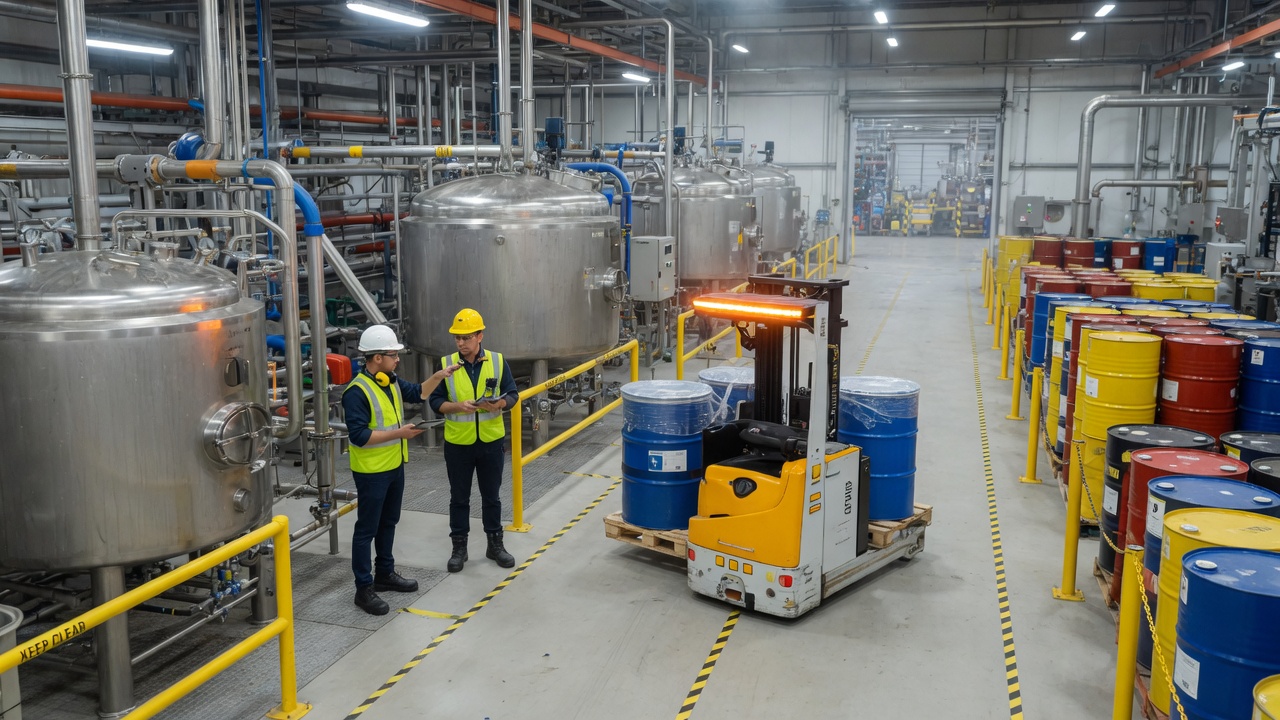
AGV Consultant for Chemical and Hazardous Manufacturing
AGV consulting for chemical manufacturing is not the same job as AGV consulting in a dry warehouse. Hazardous manufacturing adds classified areas, sealed containers, spill response, conductive flooring, mixed traffic with manned forklifts, and batch process timing. Those constraints change whether automated guided vehicles are feasible — and what they will actually cost.
Generic vendor walkthroughs miss those constraints because they start with a vehicle. Independent AGV consulting for chemical and hazardous manufacturing has to start with the process, the hazard, and the live plant. That is the only way to keep design, execution, and capital allocation from being based on a warehouse case study that does not apply. For the broader definition of the work, see what AGV consulting is.
Why Chemical Manufacturing AGV Projects Are Different
A distribution center can often absorb an extra travel loop or a delayed pickup. Chemical manufacturing often cannot. Material movements are tied to tank farm timing, packaging lines, and hazardous-material handling rules. If the AGV is late, the process waits. If the AGV takes a path that was never reviewed for classification or emergency access, the system can pass a demo and still fail a safety review.
Hazardous manufacturing also changes the capital number. Rated vehicles, special charging locations, and floor or network work that would be optional in a warehouse are often mandatory here. Independent AGV consulting has to put those items in the first study, not in a later change order.
That is why “we automated a warehouse like this” is a weak reference. Ask whether the consultant has worked in environments with:
- Flammable or combustible atmospheres and the electrical classification that follows
- Sealed drums, totes, IBCs, or other regulated containers
- Spill containment, eyewash/safety-shower access, and emergency egress that cannot be blocked
- Conductive or static-dissipative flooring requirements
- Manned forklifts sharing aisles with automated vehicles
- Existing process equipment that will not be relocated for the AGV project
What Independent AGV Consulting Must Cover
In this sector, a useful study is broader than fleet sizing. It should include:
| Area | What the consultant should test |
|---|---|
| Process fit | Which moves are stable enough to automate, and which still belong to operators |
| Hazard and classification | Where vehicles, chargers, and traffic can legally and safely operate |
| Load and containment | How drums, totes, and pallets are handled, sealed, and recovered after a stop |
| Facility constraints | Floors, slopes, drains, aisle width, door cycles, and wireless coverage |
| Mixed traffic | How AGVs coexist with forklifts, contractors, and unit operations |
| Capital risk | Infrastructure, special vehicle ratings, and operating limits that change payback |
If those items are left for the integrator after the purchase order, they become change orders. The consultant’s job is to surface them while the option set is still open. Role boundaries are covered in AGV consultant vs. system integrator.
Safety Is a Design Input, Not a Later Add-On
AGV safety systems matter in every facility. In a hazardous plant they also have to fit the existing safety case. Path design cannot block emergency equipment. Charging cannot sit in the wrong classification. Exception handling cannot assume an operator will step into a restricted area to recover a load.
That is why a warehouse-standard AGV package can look complete and still be the wrong system. Independent consulting should map vehicle behavior onto the plant’s rules, not the other way around. Related operating issues are discussed in operating AGVs in mixed-traffic environments and AGV safety systems best practices.
Capital Allocation Gets Distorted Fast
Chemical AGV projects fail financially when the quote covers vehicles and the plant later discovers rated equipment, floor work, network segmentation, or special load handling. Those items are not optional. They are the difference between a warehouse payback model and a plant payback model.
Independent AGV consulting should put those costs in the first decision, not in month six of execution. A conservative ROI that includes hazardous-area constraints is more useful than an optimistic warehouse analog. For how we think about that math, see AGV ROI calculation and maximization and what AGV consulting costs.
What a Strong Chemical-Plant Study Looks Like
- Walk the actual moves with operations, not only with the automation sponsor
- Separate flows that can be automated from flows that still need a person
- Identify classification, floor, wireless, and emergency-access constraints on the path
- Test whether AGVs, AMRs, conveyors, or process changes are the better first step
- Build a vendor-neutral scope that hazardous-area suppliers can bid against
That sequence keeps the plant from buying a standard AGV and then asking the safety team to make it legal. Process should still come before vehicle selection. We argued that generally in why process design should come before vehicle selection. In chemical manufacturing, it is not optional.
Related reading
Key Takeaways
- Chemical and hazardous AGV work is not a warehouse project with extra PPE
- Classification, containment, floors, and emergency access belong in the first study
- Vendor case studies from dry storage are a weak basis for capital approval
- Independent AGV consulting should be able to recommend not automating a given flow
- Specialized infrastructure and rated equipment must be in the payback, not in a later change order
Frequently Asked Questions
Can standard warehouse AGVs be used in a chemical plant?
Sometimes, in unclassified areas with the right load handling. Often not. The consultant’s job is to determine where a standard vehicle is acceptable and where rated equipment, path restrictions, or a different method is required.
Should EHS lead the AGV project?
EHS has to be in the room early. They should not be asked to approve a system that was designed without them. Independent consulting should bring operations, EHS, and capital into the same scope.
Is this only relevant for flammable liquids?
No. Corrosives, powders, temperature-sensitive materials, and regulated packaging all change path design, recovery procedures, and vehicle selection. The hazard type changes the details. It does not remove the need for a plant-specific study.
Do we still need a system integrator?
Yes, if the project proceeds. The integrator installs the system. The consultant should define whether the system belongs in the plant at all, and under what constraints.
Review our feasibility study scope to see how Nexus V structures independent AGV consulting for manufacturing environments.
Ready to protect your next automation investment?
Book Your Feasibility Study Today →