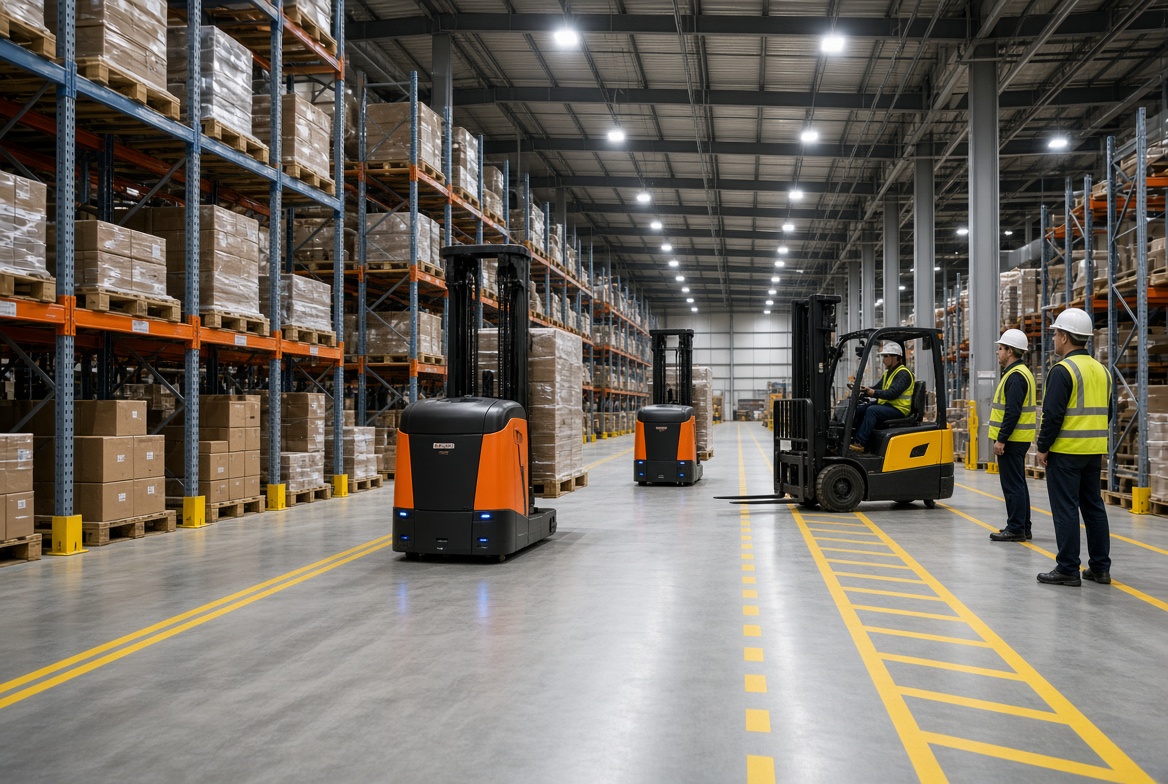
How to Successfully Operate AGVs in Mixed Traffic Environments
Most facilities cannot eliminate manual forklifts and pedestrians overnight. AGVs are frequently introduced into environments that still rely heavily on traditional equipment and people. This mixed traffic reality is one of the most common — and most expensive — sources of underperformance in AGV projects.
When traffic rules, physical layouts, and operating procedures are not carefully designed, the result is frequent stops, reduced throughput, higher exception rates, and increased safety risk. Successfully operating AGVs alongside manual equipment and pedestrians requires deliberate design of space, rules, technology, and daily behavior.
Why Mixed Traffic Is the Reality for Most Facilities
Several practical reasons prevent most operations from going fully autonomous:
- Certain tasks remain more efficient with manual equipment (irregular loads, complex stacking, high-variability put-away)
- Capital constraints force phased implementation rather than complete fleet replacement
- Peak season volume often requires temporary use of rented or existing manned trucks
- Some areas of the building are simply not practical to fully segregate
Because mixed traffic is the norm rather than the exception, the ability to manage it well often determines whether an AGV project delivers the expected return on investment.
The Core Challenges of Mixed Traffic Environments
1. Unpredictable human behavior
Manual forklift operators and pedestrians do not always follow the same predictable paths as AGVs. Shortcuts, sudden stops, and informal workarounds are common. AGVs, by design, are more rigid in their navigation and less able to improvise.
2. Congestion at shared choke points
Intersections, dock doors, charging areas, and narrow aisles become bottlenecks when both AGVs and manned equipment compete for the same space. These choke points quickly erode the productivity gains the AGV system was intended to deliver.
3. Safety perception and actual risk
Even when the technical safety systems are strong, operators and pedestrians often feel uneasy around AGVs. This discomfort can lead to workarounds, intentional blocking of vehicles, or reduced trust in the system.
4. Reduced AGV productivity
Every time an AGV is forced to stop, yield, or re-route because of a manned vehicle or pedestrian, utilization drops. Over a full shift these interruptions compound and significantly reduce effective throughput.
Poorly Managed vs Well-Managed Mixed Traffic
| Poorly Managed Mixed Traffic | Well-Managed Mixed Traffic |
|---|---|
| No formal right-of-way rules | Clear, written, and enforced traffic hierarchy |
| Shared aisles with no visual cues | Dedicated lanes, floor markings, and physical cues |
| Frequent AGV stops and re-routes | Predictable paths and minimized interaction points |
| Operators create informal workarounds | Consistent training and supervisor enforcement |
| Lower utilization and higher exception rates | Stable throughput closer to design capacity |
Design Principles for Effective Mixed Traffic Operations
1. Create clear physical and visual separation where possible
Complete segregation is ideal but often impractical. Where full separation is not possible, use painted or taped travel lanes for AGVs, physical barriers or bollards at high-risk intersections, dedicated pedestrian walkways with clear crossing points, and one-way traffic flows to reduce head-on conflicts. Even modest visual organization significantly improves predictability for both AGVs and human operators.
2. Establish formal right-of-way rules
Every facility needs a written and enforced traffic hierarchy. A common and effective approach is: pedestrians have priority in designated walkways, AGVs have priority in their primary travel lanes, and manned forklifts must yield to AGVs in AGV lanes and at controlled intersections. These rules only work when they are trained, posted, and consistently enforced by supervisors.
3. Design the layout for predictable AGV behavior
AGVs perform best when their environment is structured. This includes minimizing the number of decision points, avoiding sharp unexpected turns in high-traffic areas, providing adequate clearance and escape paths, and locating charging stations and staging areas away from primary pedestrian routes. The more predictable the AGV path, the fewer interactions and exceptions occur.
4. Use technology to reinforce safe interaction
Modern AGVs offer multiple tools that improve mixed-traffic performance, including visual indicators that clearly show the vehicle’s intended path and status, audible alerts at appropriate volume levels, zone-based speed reduction near pedestrian areas, and integration with traffic light systems or access control at critical intersections. Technology should support the rules and layout — not replace them.
Operational Best Practices
Technology and layout alone are not enough. Day-to-day operations must reinforce the design:
- Train both AGV supervisors and manned equipment drivers on the mixed-traffic rules before go-live
- Include realistic mixed-traffic scenarios in the pilot phase so problems surface early
- Monitor near-misses and stop events as leading indicators of layout or rule problems
- Adjust processes so that high-frequency manual and AGV flows do not compete for the same space at the same time when possible
- Assign clear ownership for traffic rule enforcement rather than leaving it to individual operators
- Review traffic performance regularly in the first 90 days after go-live and make targeted layout or rule adjustments
How a Feasibility Study Helps Assess Mixed Traffic Risk
One of the most valuable outcomes of a professional feasibility study is an honest assessment of how well AGVs will coexist with existing manual operations. A thorough study examines current traffic patterns and congestion points, pedestrian density by zone and time of day, existing floor markings and barriers, opportunities for physical or process segregation, and realistic expectations for AGV utilization in a mixed environment.
Facilities that skip this analysis often discover too late that their layout forces constant interaction between AGVs and manned equipment, significantly reducing the system’s effective capacity and extending the payback period.
Review our feasibility study scope to understand how traffic and layout analysis is incorporated into the assessment process.
Related Reading:
Key Takeaways
- Mixed traffic is the operating reality for most AGV installations, not a temporary inconvenience
- Clear physical organization, written right-of-way rules, and predictable AGV paths are essential
- Technology helps, but training and consistent enforcement determine long-term success
- A feasibility study should assess mixed traffic risk before major capital is committed
- Organizations that design for mixed traffic deliberately achieve better productivity and safety results
Frequently Asked Questions
Can AGVs and manned forklifts share the same aisles safely?
Yes, but only with clear lane markings, formal right-of-way rules, adequate clearance, and consistent enforcement. Unstructured shared aisles almost always reduce both safety and productivity.
Should we fully segregate AGVs from manual traffic?
Full segregation is ideal when the layout and volume allow it. In most existing facilities, complete segregation is not practical, so a combination of physical cues, rules, and process design is required.
How early should mixed traffic design be considered?
It should be evaluated during the feasibility study phase. Waiting until after vendor selection or pilot start often leads to expensive layout changes and lower system performance.
What is the biggest operational risk in mixed environments?
Inconsistent enforcement of traffic rules. When supervisors do not actively manage the interaction between AGVs and manned equipment, informal behaviors quickly erode both safety and throughput.
Mixed traffic is not a temporary inconvenience — it is the operating reality for the majority of AGV installations. Organizations that treat it as a secondary concern consistently underperform relative to their original business case. When space, rules, technology, and behavior are designed deliberately, AGVs can deliver strong results even in environments that continue to rely on manual equipment and pedestrian traffic.
Ready for an independent evaluation of your automation or AI options?
Book Your Feasibility Study Today →