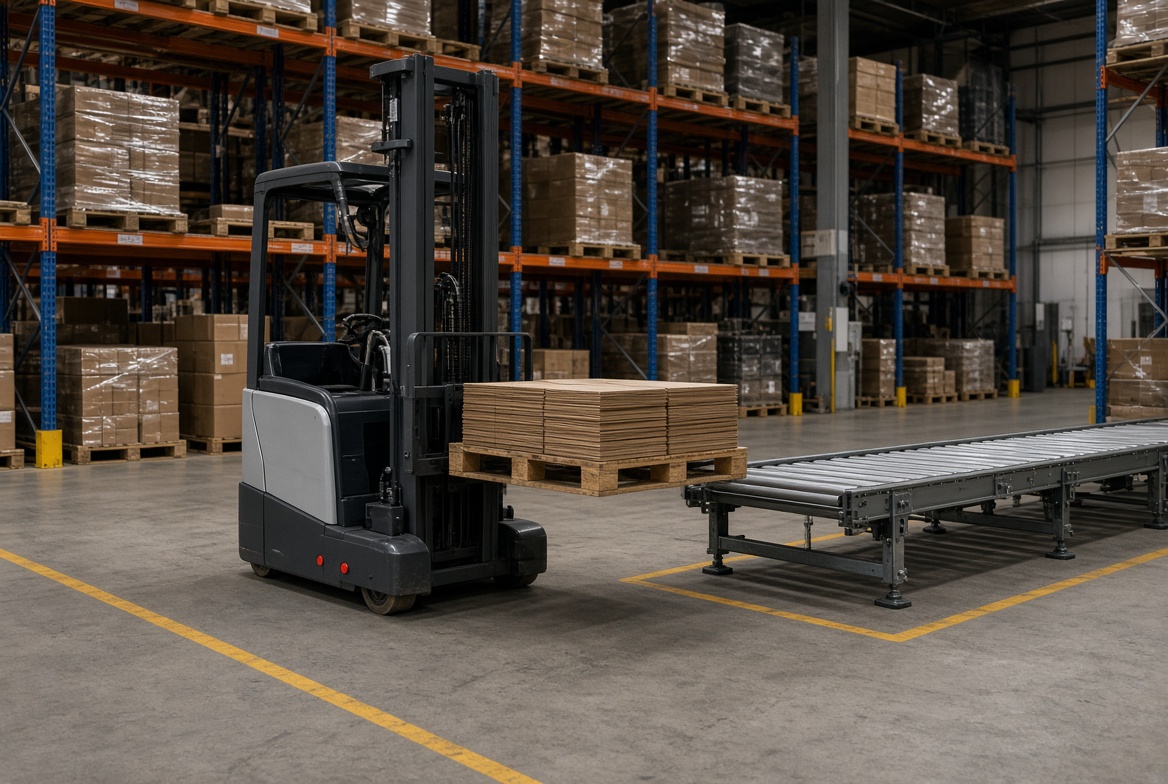
Integrating AGVs with Existing Conveyors and Material Handling Equipment
Most facilities that adopt AGVs already operate conveyors, sortation systems, palletizers, or other material handling equipment. The real performance of the AGV system often depends less on the vehicles themselves and more on how effectively they connect with this existing infrastructure.
When AGV conveyor integration is weak, transfer points become bottlenecks, exceptions increase, and overall throughput falls short of expectations. When the material handling interface is designed carefully, AGVs and conveyors function as a coordinated flow rather than two independent systems that occasionally hand work to each other. Getting this interface right is one of the highest-leverage decisions in an AGV project.
Why AGV and Conveyor Integration Determines System Performance
Poor integration between AGVs and existing material handling equipment creates several recurring problems:
- AGVs wait for available induction or discharge points
- Conveyors become starved or overloaded due to timing mismatches
- Manual interventions increase at AGV transfer points
- Overall system throughput falls below design targets
- Utilization of both AGVs and conveyors declines
These issues are rarely caused by the vehicles or the conveyors individually. They stem from the interface between them. Facilities that treat AGV conveyor integration as a secondary detail often discover after go-live that the transfer points are the limiting factor on the entire system.
Key Elements of Successful Material Handling Interface Design
1. Physical interface and transfer geometry
The physical handoff between AGVs and conveyors must be precise. This includes matching elevations, load orientation, approach angles, and clearance for the AGV to align and transfer without interference. Small mismatches in height or positioning create repeated exceptions and force operators to intervene. Clean AGV transfer points require deliberate mechanical design, not just placing a conveyor near an AGV path.
2. Timing and flow balance
AGVs arrive in discrete cycles while conveyors typically run continuously or in high-frequency pulses. Without proper buffering or sequencing, one side consistently waits on the other. Effective AGV conveyor integration accounts for these different rhythms and includes accumulation or staging where needed to keep both systems productive.
3. Control system communication
Reliable communication between the AGV fleet manager and the conveyor control system (or higher-level WMS/WCS) is essential. Status signals, transfer requests, clearance messages, and fault conditions must be exchanged accurately and with low latency. Weak or incomplete messaging is a frequent source of stalled transfers and manual resets.
4. Traffic management around transfer points
AGV transfer points often become congestion zones, especially in mixed-traffic environments. Clear rules for approach, queuing, and departure, combined with adequate space, prevent vehicles from blocking each other or interfering with manned equipment.
5. Exception handling at the interface
When a transfer fails — due to misalignment, sensor error, or communication drop — the system needs a defined recovery path. Without standardized exception handling, these failures become chronic sources of downtime and operator intervention.
Common Integration Approaches
| Approach | Best Suited For |
|---|---|
| Direct AGV-to-conveyor transfer | High-volume, consistent loads with precise positioning requirements |
| AGV to staging position + conveyor pickup | Operations needing buffering or load reorientation |
| Conveyor to AGV pickup stations | Outbound or sortation-driven flows |
| Hybrid with short accumulation conveyors | Systems requiring decoupling of AGV and conveyor timing |
Practical Recommendations for Strong Integration
- Define AGV conveyor integration requirements early in the feasibility and design phase rather than treating them as details to resolve later
- Map expected volume, timing, and load characteristics at each transfer point
- Include buffering or accumulation where AGV and conveyor cycle times differ significantly
- Design clear approach and departure paths that minimize conflicts with other traffic
- Establish standard recovery procedures for failed transfers at AGV transfer points
- Validate communication protocols between the AGV system and existing controls before finalizing the design
- Involve both the AGV provider and the conveyor/controls team in interface definition to avoid ownership gaps
How a Feasibility Study Reduces Integration Risk
Many of the most expensive integration problems can be identified before equipment is purchased. A thorough feasibility study evaluates existing conveyor layouts, physical constraints, control system capabilities, expected material flow volumes, and potential AGV transfer points. This early analysis allows the material handling interface to be designed deliberately rather than improvised during installation.
Review our feasibility study scope to see how material handling interfaces and existing equipment are assessed.
Related Reading:
Key Takeaways
- Successful AGV projects depend heavily on how well vehicles connect with existing conveyors and material handling equipment
- Physical interfaces, timing, control communication, and exception handling all require deliberate design
- Treating AGV conveyor integration as a secondary detail is one of the fastest ways to create bottlenecks and manual interventions
- Early evaluation during the feasibility phase significantly reduces later risk and cost
- The goal is a coordinated material flow system, not two independent technologies that occasionally interact
Frequently Asked Questions
Can AGVs work effectively with older conveyor systems?
Yes, in many cases. The key is understanding the physical constraints, control capabilities, and required interface logic. Older systems may need modest upgrades to sensors, signaling, or accumulation zones to support reliable AGV conveyor integration.
Should the AGV vendor or the conveyor supplier lead the integration?
Clear ownership is essential. In most successful projects, one party is designated as the integration lead, with defined responsibilities for interface design, testing, and exception handling at the material handling interface.
How early should AGV transfer requirements be defined?
As early as possible — ideally during the feasibility study. Waiting until after vehicle selection often leads to compromises, higher costs, and weaker overall system performance.
What is the biggest risk of weak integration?
Chronic bottlenecks at AGV transfer points that limit overall system throughput and increase manual interventions, even when both the AGVs and conveyors are individually capable.
AGVs deliver the greatest value when they function as part of a larger material handling system rather than as a standalone technology. Facilities that invest the time to design clean interfaces with existing conveyors and equipment consistently achieve higher utilization, fewer exceptions, and stronger returns on their automation investment. Those that treat the material handling interface as an afterthought often find that the transfer points become the limiting factor on the entire system.
Ready for an independent evaluation of your automation or AI options?
Book Your Feasibility Study Today →