What to Expect During an AGV Feasibility Study: A Step-by-Step Guide
Many companies make the costly mistake of jumping straight into vendor meetings and proposals without first understanding whether AGVs are even the right solution for their operation — or what the true costs, timeline, and risks will actually be. This is one of the most expensive mistakes you can make in automation.
A professional, independent AGV feasibility study is the single best investment you can make before committing capital to any automated guided vehicle project. It gives you objective data, removes vendor bias, and delivers a clear roadmap so you can move forward with confidence.
In this comprehensive guide, we’ll walk you through exactly what a high-quality feasibility study includes, what you’ll receive at the end, and why it’s dramatically different from (and far more valuable than) a typical vendor-provided assessment.
Step 1: Kickoff Meeting & Data Collection
The process begins with a structured discovery session. We sit down with your operations, engineering, IT, finance, and safety teams to understand your current state, pain points, and future goals.
You’ll be asked to provide:
- Current facility layout (CAD files or scaled PDFs)
- Throughput data (pallets, cases, or units per hour/day by area)
- Labor costs and headcount by shift and department
- Existing equipment inventory, age, and maintenance costs
- WMS/ERP/MES system details and integration capabilities
- Growth projections for the next 3–5 years
- Known bottlenecks, safety incidents, or labor challenges
- Any previous automation studies or vendor proposals
The quality of your data directly impacts the accuracy of our recommendations. We’ve seen projects where incomplete data led to 30–40% variances in actual vs. projected ROI. That’s why we invest significant time in this phase — it’s the foundation everything else is built on.
Step 2: On-Site Assessment & Material Flow Analysis
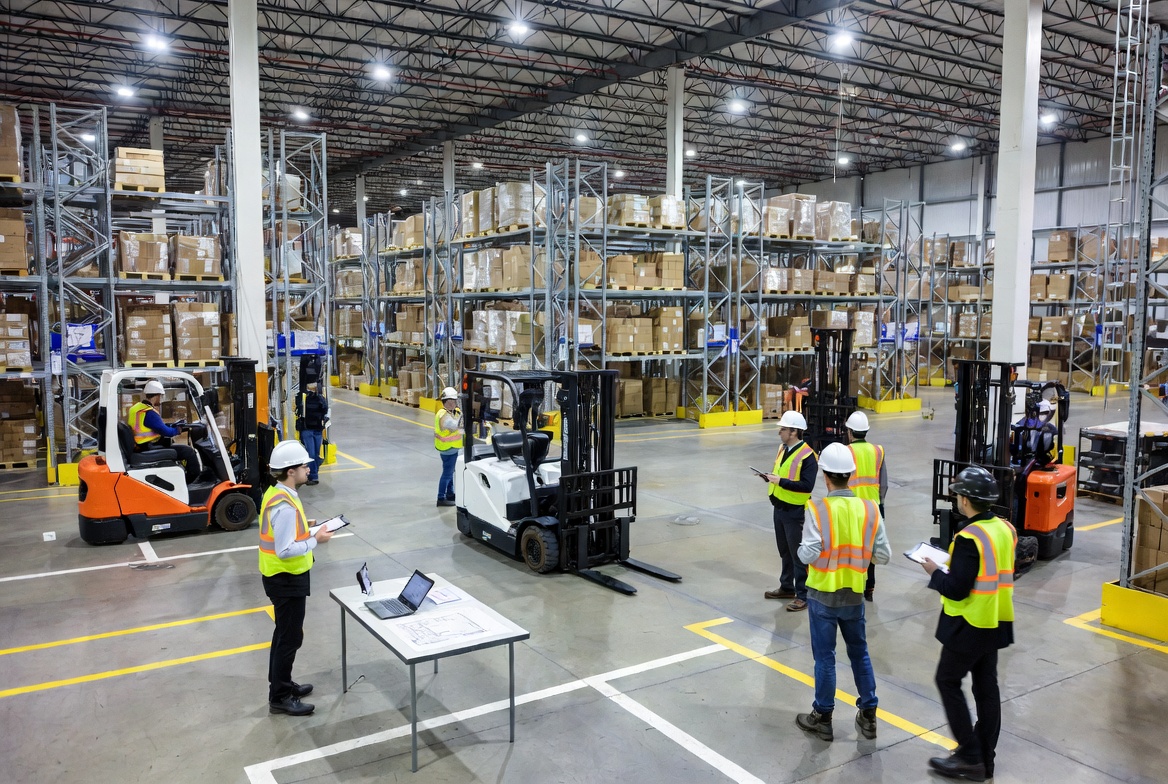
Our team conducts a multi-day site visit to evaluate real-world conditions. We don’t just review drawings — we walk the floor, observe operations during peak and off-peak periods, and talk to the people who actually move product every day.
Key activities include:
- Detailed floor condition mapping (flatness, cracks, coatings, transitions)
- Network infrastructure testing (WiFi coverage, latency, interference)
- Safety and regulatory compliance review (OSHA, fire codes, pedestrian/vehicle separation)
- Traffic pattern analysis and congestion heat mapping
- Current material flow tracing from receiving to shipping
- Peak vs average demand profiling by hour and day of week
- Existing equipment utilization and maintenance history review
This is where many “desktop” feasibility studies fall short. Real-world conditions often differ significantly from what’s on the drawings. We’ve seen facilities where floor conditions in 35% of the space needed remediation before AGVs could operate safely — something that would have been missed without an on-site assessment.
Step 3: Technical Feasibility & High-Level Solution Design
We evaluate which AGV technologies are technically viable for your specific environment. This is not a sales pitch — it’s an objective assessment of what will actually work.
Areas we analyze:
- Navigation method suitability (laser, natural feature, magnetic, vision, SLAM)
- Vehicle type recommendations (counterbalance fork, reach truck, tug, unit load, custom)
- Charging strategy comparison (opportunity charging vs. battery swap vs. inductive)
- Integration requirements with your existing WMS, ERP, and MES systems
- Necessary facility modifications (floor repairs, network upgrades, safety infrastructure)
- Scalability for future growth or layout changes
You’ll receive a high-level solution concept — not a full engineering design, but enough detail to understand what success looks like and what major decisions need to be made.
Step 4: Financial Analysis & ROI Modeling
This is where the rubber meets the road. We build a comprehensive total cost of ownership (TCO) model that includes all relevant costs and benefits over a 5–7 year horizon.
Our model typically includes:
- Capital equipment costs (vehicles, chargers, software, peripherals)
- Infrastructure and installation (floor work, network, safety systems, racking modifications)
- Training, change management, and project management
- Ongoing maintenance, support, and spare parts
- Energy and consumables
- Direct labor savings (headcount reduction or redeployment)
- Indirect labor benefits (reduced overtime, turnover, training costs)
- Throughput improvements and capacity gains
- Reduced product damage and improved inventory accuracy
- Risk-adjusted ROI, payback period, and NPV under multiple scenarios
We run conservative, base, and optimistic scenarios so you can see how different assumptions affect the financial outcome. This gives you defensible numbers for capital approval and helps set realistic expectations with leadership.
Step 5: Risk Assessment & Mitigation Planning
Every AGV project carries risks. We identify the most likely ones for your specific operation and provide concrete, actionable mitigation strategies.
Common risk categories we evaluate:
- Technology performance risk (will the AGVs actually achieve the claimed speeds and reliability?)
- Integration complexity (how difficult will it be to connect with legacy systems?)
- Change management and workforce adoption (how will operators and supervisors react?)
- Timeline slippage (what are the most common causes of delay?)
- Budget overruns (where do projects most often go over budget?)
- Vendor dependency and long-term support risk
You’ll leave with a clear risk register and mitigation plan so you’re never surprised during implementation.
Step 6: Implementation Roadmap & Recommendations
The final deliverable is a phased implementation plan tailored to your operation, budget, and risk tolerance.
Your roadmap typically includes:
- Recommended project phases and sequencing
- Realistic timeline with key milestones and decision gates
- Resource requirements (internal team time, external partners)
- Vendor selection criteria and RFP template (vendor-neutral)
- Change management and training considerations
- Go/no-go decision points with clear criteria
Because we don’t sell equipment or earn commissions from vendors, our recommendations are truly unbiased. We tell you what’s best for your operation — not what maximizes someone else’s profit margin.
Real-World Example: Distribution Center Feasibility Study
A 280,000 sq ft distribution center moving 2,400 pallets per day was experiencing chronic labor shortages and throughput bottlenecks during peak periods. Their primary AGV vendor proposed a 12-vehicle solution for $2.1 million with a claimed 22-month payback.
Our independent feasibility study revealed several critical issues the vendor had downplayed or missed:
- Actual peak demand was 35–40% higher than average — the 12-vehicle fleet would have been chronically undersized during rush periods, leading to truck detention, production line starvation, and overtime costs the vendor’s model didn’t fully capture.
- Floor conditions in 35% of the facility needed remediation before AGVs could operate safely and reliably at the speeds required to hit throughput targets.
- WiFi coverage had significant dead zones that would have caused navigation failures and downtime.
- Integration with their legacy WMS would require custom middleware and 4–6 months of additional development — pushing the real go-live date out significantly.
Our recommended solution: 17 AGVs with opportunity charging, targeted floor repairs in high-traffic zones, network infrastructure upgrades, and phased rollout over 16 months. Total investment: $2.85 million.
Financial comparison:
- Vendor proposal: $2.1M investment, 22-month payback (optimistic), but actual results would have been 18–24% below projected throughput due to undersizing and infrastructure issues. The client would have needed a $1.2M emergency fleet expansion 18 months later.
- Independent recommendation: $2.85M investment, 29-month payback, but 31% higher sustainable throughput, significantly lower risk, and 38% better 5-year NPV.
The extra $750,000 investment extended the payback period by roughly 7 months, but delivered dramatically better long-term economics. The client avoided an emergency fleet expansion that would have been required with the undersized vendor solution. More importantly, they achieved consistent on-time shipping performance and avoided hundreds of thousands in truck detention fees and lost sales during peak seasons.
This is the realistic outcome of proper sizing: sometimes you spend a bit more upfront and take slightly longer to break even, but the total value created over 5 years is substantially higher — and you avoid the painful (and expensive) surprises that derail so many AGV projects.
Independent Feasibility Study vs. Vendor Study
| Aspect | Independent Feasibility Study | Typical Vendor Study |
|---|---|---|
| Primary Objective | Find the best solution for your operation | Sell as much equipment as possible |
| Fleet Size Recommendation | Data-driven, often different from initial vendor quote | Usually higher (more vehicles = more revenue) |
| Infrastructure Requirements | Fully evaluated and realistically costed | Often underestimated or excluded |
| Risk Assessment | Comprehensive with specific mitigation strategies | Minimal or overly optimistic |
| Integration Complexity | Realistically assessed with timeline impact | Frequently downplayed |
| ROI Model | Conservative, multi-scenario, risk-adjusted | Often uses best-case assumptions |
| Recommendations | Completely vendor-neutral | Biased toward their own products and services |
| Cost to You | Fixed fee ($8,500–$15,000) | Usually “free” (but you pay in other ways) |
What You Receive at the End of the Study
When the study is complete, you’ll receive a comprehensive package that includes:
- Detailed report with executive summary for leadership
- Comprehensive financial model with multiple scenarios
- High-level facility layout concepts and AGV flow diagrams
- Detailed WiFi coverage and performance assessment with heat map
- Complete risk register with mitigation strategies
- Phased implementation roadmap with timeline and milestones
- Vendor selection criteria and sample RFP template
- Follow-up support to answer questions and refine recommendations
Key Takeaways
- A feasibility study is the highest-ROI activity you can do before an AGV project
- Independent studies remove vendor bias and give you real negotiating power
- The process typically takes 3–5 weeks depending on facility size and complexity
- You’ll receive a clear go/no-go recommendation with supporting data
- Most clients discover their initial assumptions were off by 20–40%
- The cost of a study is typically less that 1% of total project investment — cheap insurance
Ready to Remove the Guesswork?
Stop hoping an AGV project will work. Start with the data you need to make the right decision the first time — and avoid the expensive surprises that derail so many automation initiatives.
Ready to protect your next automation investment?
Book Your Feasibility Study Today →