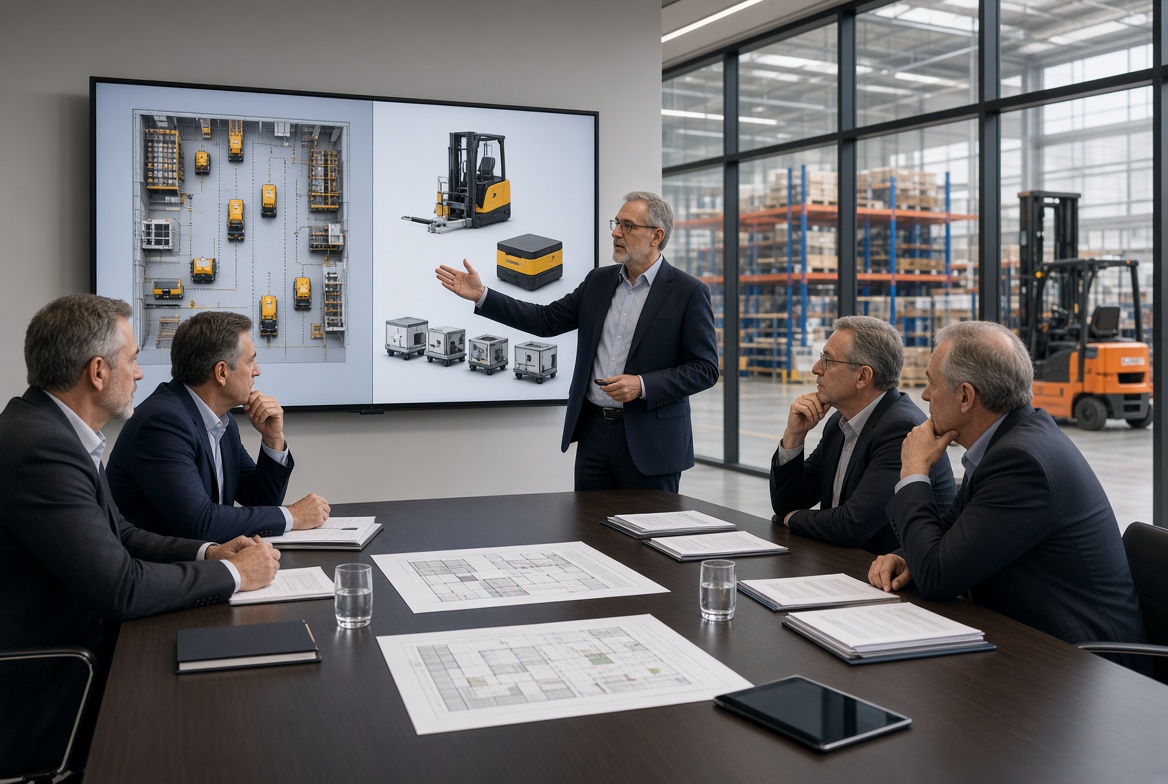
Warehouse Automation Consulting vs. Going Straight to an AGV Manufacturer
Many manufacturers start an AGV project by calling an AGV manufacturer. That is understandable. The manufacturer knows its vehicles, can quote quickly, and often offers a complimentary site visit. The problem is that a manufacturer’s job is to sell and support its product line. Warehouse automation consulting has a different job: decide whether automation is the right move, what process changes are required, and which type of solution — if any — fits the operation.
Those two paths are not interchangeable. Going straight to an AGV manufacturer can be the right second step. It is usually a weak first step when the process, facility constraints, and business case are still undefined.
What Warehouse Automation Consulting Is Designed to Do
Warehouse automation consulting looks at the operation first. An independent consultant reviews material flow, labor use, layout, facility conditions, and project objectives before recommending equipment. The goal is a decision: proceed, pause, redesign the process, or choose a different automation approach.
That work often includes AGV consulting, but it is broader than vehicle selection. A consultant should be willing to conclude that conveyors, process changes, or no automation at all is the better answer. That independence is the point. For a clearer definition of the AGV-specific version of this work, see what AGV consulting is.
What Happens When You Go Straight to an AGV Manufacturer
An AGV manufacturer starts with the products it can deliver. The conversation quickly moves to vehicle type, navigation method, estimated fleet size, and a proposal. That can be useful after requirements are defined. Before that, it creates three common problems:
- The recommended solution is limited to one product family
- Facility and process risks are treated as later implementation details
- The proposal becomes the baseline even if the underlying assumptions are weak
None of that means manufacturers are untrustworthy. It means their incentive is different. They are not paid to tell you the application is a poor fit. Independent warehouse automation consulting is.
Side-by-Side Comparison
| Decision point | Warehouse automation consulting | AGV manufacturer first |
|---|---|---|
| Starting question | Is this operation ready for automation? | Which of our vehicles can do this? |
| Process design | Reviewed before equipment is chosen | Often assumed or left for later |
| Technology options | Vendor-neutral | Limited to the manufacturer’s line |
| Risk discussion | Documented before capital is committed | Often minimized to keep the deal moving |
| Typical output | Feasibility conclusion and next-step roadmap | A product proposal |
| Best used when | The decision is still open | Requirements are already defined |
When Going to an AGV Manufacturer First Makes Sense
There are cases where calling a manufacturer early is reasonable:
- The process is stable and already well documented
- The facility constraints are understood
- Leadership has already decided AGVs are the right category
- The team only needs budgetary input from a known technology
Even then, treat the manufacturer’s study as one input. It is not a substitute for an independent feasibility review. Manufacturer estimates are useful. They should not be the only analysis used to approve capital.
When Consulting Should Come First
Warehouse automation consulting should come first when any of these are true:
- Vendors are already offering different answers
- The current process is inconsistent or poorly measured
- Floor conditions, mixed traffic, Wi-Fi, or layout may limit AGV performance
- Finance needs a defensible case, not a sales quote
- The team has limited AGV implementation experience
In those situations, going straight to an AGV manufacturer usually produces a proposal that looks complete and still leaves the hard questions unanswered. That is how companies buy a system that is technically impressive and operationally constrained. We covered the downstream version of that problem in why independent AGV consulting delivers better outcomes than going direct to vendors.
The Hidden Cost of Starting With the Manufacturer
The cost is not only the consulting fee you skipped. It is the loss of negotiating position. Once a manufacturer’s concept is circulating internally, it becomes the default design. Competing options are then judged against that design instead of against the operation’s actual requirements.
That creates a second problem during proposal comparison. If every quote is built on different assumptions, price stops being a useful signal. Independent consulting creates a common basis first. Then manufacturer proposals can be compared on scope, risk, and total cost. Use the same discipline described in how to evaluate competing AGV proposals objectively.
A Practical Sequence That Works
- Define the process and the decision you need to make
- Use warehouse automation consulting to test feasibility and risks
- If the project is feasible, write requirements that are vendor-neutral
- Then invite AGV manufacturers to propose against that scope
That sequence does not slow a good project down. It prevents a weak project from moving fast in the wrong direction. A professional feasibility study should determine whether the project is feasible. It should not skip that question and jump into detailed system sizing.
Related reading
Key Takeaways
- Warehouse automation consulting and AGV manufacturers solve different problems
- Manufacturers are strongest after requirements are defined
- Consulting should come first when the process, risks, or business case are still open
- Starting with one manufacturer often turns that product line into the default design
- Independent feasibility work creates a cleaner basis for later manufacturer proposals
Frequently Asked Questions
Is warehouse automation consulting the same as AGV consulting?
AGV consulting is a focused subset. Warehouse automation consulting can include process design, conveyors, layout, and other methods. Both should stay vendor-neutral if the goal is a capital decision rather than a product sale.
Can an AGV manufacturer also act as a consultant?
They can advise on their own equipment. That is not the same as independent warehouse automation consulting. The manufacturer still has a product to sell.
Will consulting delay the project?
A structured feasibility study typically takes a few weeks. That is shorter than the delay created by discovering process or facility issues after a manufacturer contract is signed.
When should we talk to AGV manufacturers?
After the operation, constraints, and success criteria are defined well enough that competing proposals can be compared on the same basis.
Review our feasibility study scope to understand why a feasibility study is the proper first step in an AGV implementation.
Ready to protect your next automation investment?
Book Your Feasibility Study Today →