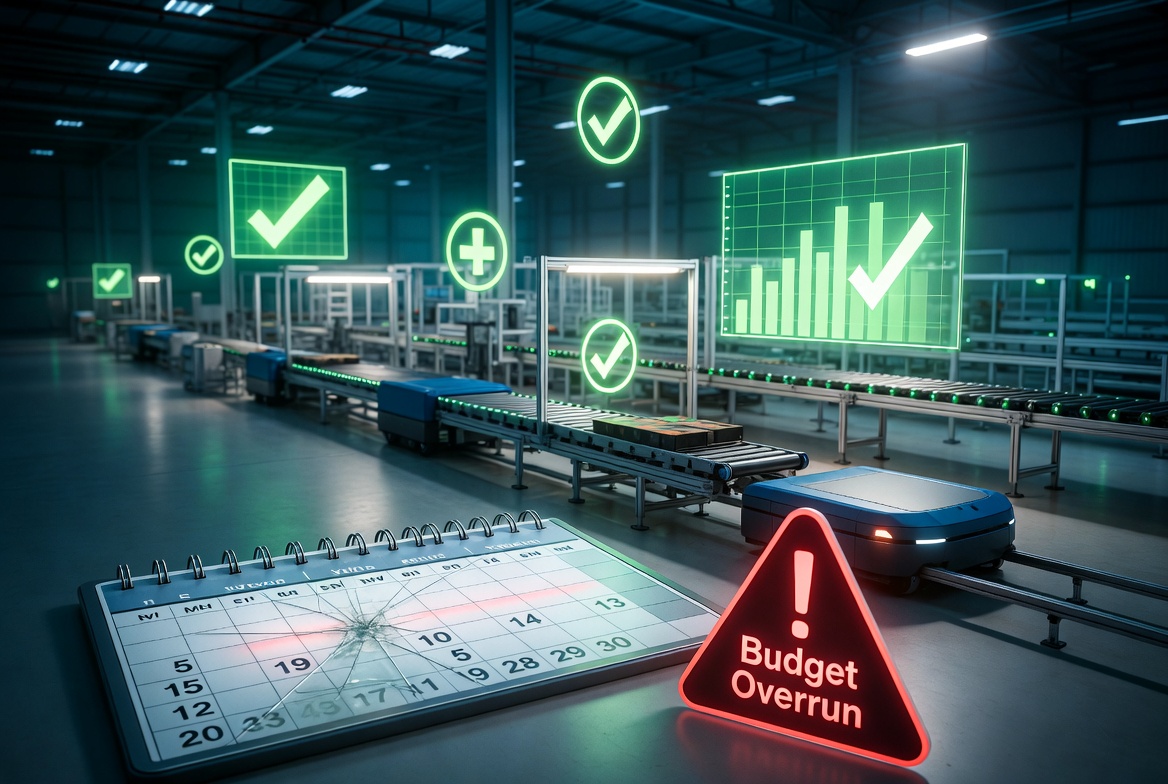
The Real Cost of Automation Projects: How to Avoid Budget Overruns and Timeline Disasters
Labor shortages, space constraints, and project uncertainties already make automation investments feel risky. When a project also blows past budget and misses deadlines, the consequences can be devastating — lost production, damaged vendor relationships, and years of delayed ROI.
Why Most Automation Projects Go Over Budget and Timeline
The true cost of an automation project is rarely what appears on the initial quote. Hardware and software typically represent only 40–60% of the total investment. The rest hides in integration challenges, facility modifications, training, downtime, and unforeseen risks. Without a clear upfront picture, even well-intentioned projects can spiral.
The Most Expensive Hidden Costs
- Integration and downtime costs – Connecting new AGV systems or conveyors to existing WMS/ERP often requires far more custom work than anticipated.
- Facility modifications and infrastructure upgrades – Floor reinforcement, power drops, network cabling, and safety fencing can add significant expense after the quote is signed.
- Training and change management – Operators, maintenance teams, and IT staff need time to adapt; productivity often drops during the transition.
- Scope creep and change orders – Unclear requirements discovered mid-project lead to expensive modifications.
- Regulatory and safety compliance – Overlooked requirements in narrow-aisle, food-grade, or hazardous environments can halt progress.
- Post-go-live optimization – Many systems need months of fine-tuning to reach expected performance levels.
How Nexus V Helps You Avoid These Disasters
Our fixed-price Feasibility Study is specifically designed to surface these hidden costs and risks early — before you commit significant capital. Delivered in 3–4 weeks and typically priced between $8,500 – $15,000 (project-dependent), the study includes a thorough assessment of your operations, including a site visit.
You receive four clear deliverables:
- Project Background and Current State Assessment – Detailed review of your operational objectives, facility layout, material flow, throughput volumes, existing equipment, pain points, and project requirements.
- Proposed Solution & Technical Feasibility – Recommended system architecture, technical compatibility analysis, integration requirements, safety and regulatory compliance review, and vendor options evaluated.
- Financial Analysis & ROI Assessment – Capital investment summary, projected annual benefits, ROI metrics (payback period, NPV, IRR), key assumptions, and sensitivity analysis.
- Risks, Mitigation & Implementation Roadmap – Identified risks with mitigation strategies, phased implementation timeline, critical needs, recommendations, and immediate next steps.
This comprehensive deliverable removes the guesswork and gives you clear, objective data and the confidence to move forward — or adjust course — before expensive mistakes are made.
Why a Feasibility Study Is the Smartest First Step
Manufacturing and warehousing leaders face increasing pressure to automate. Yet jumping straight to vendor proposals without an independent assessment is one of the most common — and costly — mistakes. A professional feasibility study acts as an insurance policy for your automation investment. It surfaces issues early, aligns stakeholders, and provides a realistic roadmap grounded in your actual facility and operations.
Ready to Move Forward with Confidence?
Don’t let hidden costs derail your next automation project. Nexus V’s fixed-price Feasibility Study gives you the clarity you need — in just 3–4 weeks — so you can invest with confidence and protect your ROI from day one.
Ready to protect your next automation investment?
Book Your Feasibility Study Today →