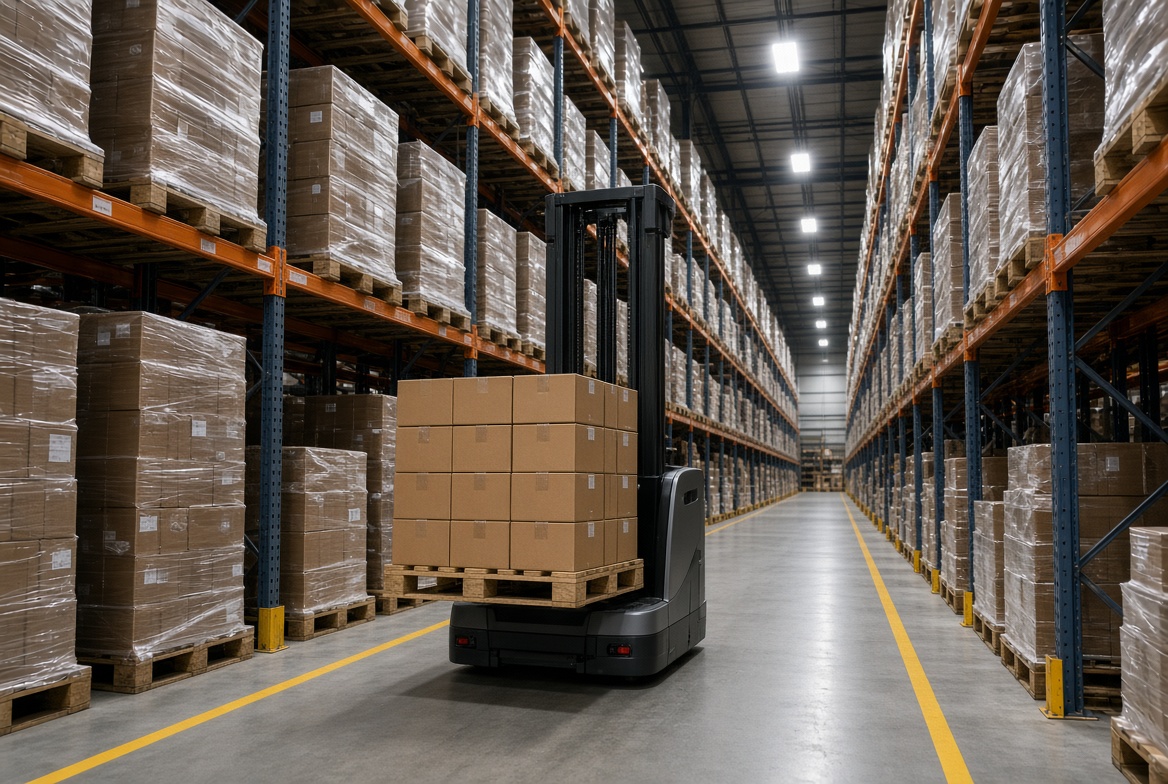
Narrow-Aisle AGVs: When They Make Sense (and When They Don’t)
Narrow-aisle AGVs are often presented as the solution for facilities that need more storage capacity without expanding their building. In the right application, they deliver exactly that — higher density, better space utilization, and strong returns. In the wrong application, they introduce complexity, reduce flexibility, and create operational constraints that outweigh the density gains.
Understanding when narrow-aisle AGVs make sense (and when they do not) is essential before committing capital or redesigning a warehouse layout around them.
What Makes an AGV “Narrow-Aisle”
Narrow-aisle AGVs are designed to operate in aisles significantly tighter than those used by conventional forklifts or standard AGVs. Typical aisle widths can range from roughly 5.5 to 7.5 feet depending on the vehicle type and load. These systems usually combine specialized navigation, precise positioning, and often very-narrow-aisle (VNA) or turret-style capabilities to work effectively in constrained spaces.
The primary value proposition is storage density. By reducing aisle width, more of the building footprint can be dedicated to racking rather than travel paths.
When Narrow-Aisle AGVs Make Sense
Narrow-aisle AGVs tend to perform well under these conditions:
1. Storage density is the dominant constraint
When the facility is already near capacity and expanding the building is expensive or impractical, the density gains from narrower aisles can justify the investment and the operational trade-offs.
2. Product mix and load profiles are relatively consistent
Narrow-aisle systems work best when loads are standardized in size, weight, and handling requirements. High variability in pallet dimensions or special handling needs reduces efficiency and increases exceptions.
3. Throughput requirements are moderate and predictable
Very high or highly variable throughput can stress narrow-aisle layouts because travel paths are constrained and overtaking is limited. Facilities with steady, mid-range throughput often see the best results.
4. The facility can support precise floor and guidance conditions
Narrow-aisle AGVs are less tolerant of floor irregularities, poor lighting, or inconsistent racking alignment than standard AGVs. Facilities that can meet these requirements (or are willing to invest in improvements) are better candidates.
5. Long-term layout stability is expected
Once a warehouse is configured for narrow-aisle operation, changing the layout later is costly. Operations that expect stable product profiles and processes for several years are better suited than those anticipating frequent reconfiguration.
When Narrow-Aisle AGVs Often Do Not Make Sense
Several situations commonly lead to disappointment with narrow-aisle AGVs:
- High SKU variability or frequent layout changes — Constrained aisles reduce operational flexibility.
- Very high throughput or peaky demand — Limited ability to add parallel travel paths can create bottlenecks.
- Mixed traffic that cannot be fully separated — Pedestrians or manned equipment in narrow aisles increase risk and complexity.
- Poor existing floor conditions — The cost of floor remediation can erode the density ROI.
- Need for frequent manual intervention — Tight spaces make exception handling slower and more difficult.
Key Trade-Offs to Evaluate
| Advantage | Corresponding Trade-Off |
|---|---|
| Higher storage density | Reduced layout flexibility |
| More pallet positions per square foot | Tighter operating tolerances |
| Potential building cost avoidance | Higher vehicle and infrastructure cost per unit |
| Efficient use of vertical space | More complex recovery from exceptions |
Critical Questions Before Committing
- Is storage density truly the binding constraint, or are process and flow issues the larger problem?
- How stable is the product mix and order profile over the next 5–7 years?
- Can the existing floor and racking meet the tighter tolerances required?
- What is the realistic cost of facility modifications needed to support narrow-aisle operation?
- How will peak demand and exception handling be managed in constrained aisles?
- Is the organization prepared for the operational discipline that narrow-aisle systems require?
The Role of a Feasibility Study
Narrow-aisle AGVs should never be selected based solely on density calculations or vendor demonstrations. A proper feasibility study examines the full set of trade-offs: density gains versus flexibility loss, vehicle cost versus building cost avoidance, and operational risk versus performance upside. It also validates whether the facility’s physical conditions and process characteristics can support reliable narrow-aisle operation.
Review our feasibility study scope to understand how these factors are assessed.
Related Reading:
Key Takeaways
- Narrow-aisle AGVs excel when storage density is the primary constraint and operating conditions are stable
- They introduce meaningful trade-offs in flexibility, exception handling, and facility requirements
- High variability, high throughput, or poor floor conditions often make them a poor fit
- The decision should be driven by a full analysis of density gains versus operational and capital trade-offs
- A structured feasibility study is the most reliable way to determine whether narrow-aisle AGVs are the right solution
Frequently Asked Questions
How much density improvement can narrow-aisle AGVs typically deliver?
Results vary widely by current layout, but many facilities see meaningful increases in pallet positions within the same footprint. The exact gain depends on existing aisle widths, racking design, and vehicle capabilities.
Are narrow-aisle AGVs more expensive than standard AGVs?
Vehicle cost is often higher, and facility modifications can add cost. The economic case usually rests on avoided building expansion or significantly higher storage capacity rather than lower equipment cost.
Can narrow-aisle AGVs operate in mixed-traffic environments?
It is possible but more challenging. Tight aisles leave little room for safe interaction with pedestrians or manned equipment. Many successful installations separate traffic or carefully control access.
What is the biggest risk of choosing narrow-aisle AGVs incorrectly?
Locking the facility into a less flexible layout that becomes a constraint when product mix, volume, or processes change — while still carrying the higher cost and tighter operating requirements of the system.
Narrow-aisle AGVs are a powerful tool when storage density is the real problem and the operation can support the required discipline and physical conditions. They are a costly constraint when applied for the wrong reasons. The difference between these two outcomes is almost always determined by how thoroughly the application is evaluated before the decision is made.
Ready for an independent evaluation of your automation or AI options?
Book Your Feasibility Study Today →