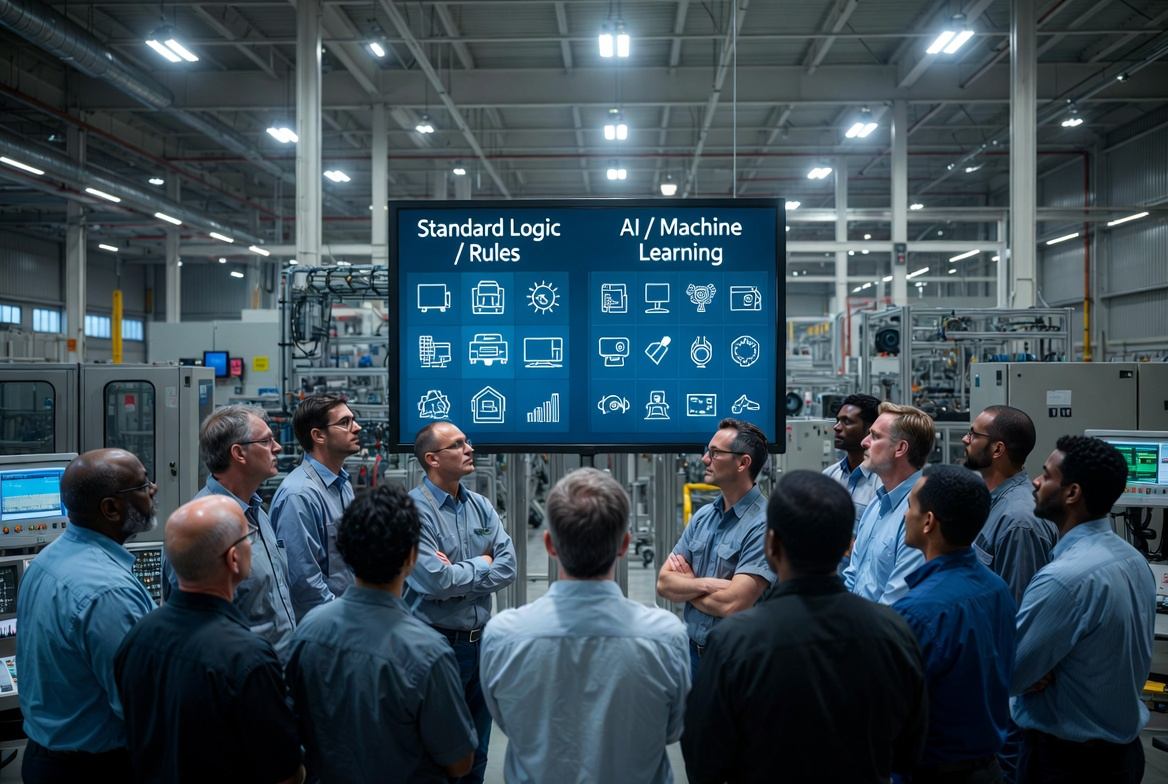
Do You Actually Need AI and How to Tell the Difference Between Real AI and Standard Logic
One of the most common and costly mistakes companies make today is assuming they need AI when standard logic would solve the problem more effectively — and far more cheaply. Equally common is accepting a solution labeled “AI” that is, in reality, just a rules-based system with modern marketing.
Before investing in AI, operations leaders should answer two critical questions:
- Do we actually need AI, or would standard logic be sufficient?
- If AI is required, is the proposed solution truly AI — or just advanced programming?
Why This Distinction Matters
Real AI (typically machine learning or related techniques) brings additional complexity, data requirements, ongoing model maintenance, and cost. Standard logic or rules-based systems are usually simpler, more transparent, easier to maintain, and less expensive to implement and operate.
Choosing AI when it is not needed often leads to higher costs, longer timelines, and systems that are harder to troubleshoot. Choosing a solution that is marketed as AI but is not actually AI leads to mismatched expectations and potential disappointment when the system cannot adapt or improve over time.
AI vs. Standard Logic: A Clear Comparison
| Factor | Standard Logic / Rules-Based | Real AI (Machine Learning) |
|---|---|---|
| Best When | Rules are clear and stable | Patterns are complex or changing |
| Transparency | High – decisions are explainable | Lower – models can be harder to interpret |
| Maintenance | Update rules as needed | Requires monitoring and retraining |
| Data Requirements | Relatively low | Higher – needs quality historical data |
| Cost & Complexity | Generally lower | Generally higher |
| Adaptation | Manual updates required | Can improve with new data |
When Standard Logic Is the Better Choice
Standard logic or rules-based systems are often the right solution when:
- The decision rules are well understood and relatively stable
- The inputs and outcomes can be clearly defined in advance
- The process does not require continuous learning or adaptation
- Transparency and predictability are more important than adaptability
- The volume or complexity of data does not justify a learning system
In many warehouse and manufacturing environments, a well-designed rules engine or traditional optimization approach can deliver excellent results without the overhead of AI. For example, slotting rules, replenishment triggers, or basic routing logic can often be handled effectively with clear, maintainable rules rather than a learning model.
When Real AI Is Actually Needed
Genuine AI (most often machine learning) becomes valuable when:
- Patterns are too complex or numerous to define with explicit rules
- The system needs to improve over time as more data becomes available
- Conditions change frequently and rules would require constant manual updates
- Predictions or classifications must be made from large, noisy, or high-dimensional data
- Human experts cannot reliably articulate the full decision logic
Examples include certain types of predictive maintenance, demand sensing with many variables, visual quality inspection with high variation, or complex routing optimization under changing constraints.
How to Tell If a Solution Is Actually AI
Many vendors apply the “AI” label to systems that are primarily rules-based or use traditional algorithms. Useful questions to ask include:
- Does the system learn and improve from new data without manual rule updates?
- Was a model trained on historical data, or are decisions driven by predefined rules?
- How does the system handle situations it has not seen before?
- What happens when the underlying patterns in the data change?
- Can the vendor clearly explain what type of model is used and how it is maintained?
If the system relies primarily on if-then rules, thresholds, or fixed decision trees written by engineers, it is not AI in the meaningful sense — even if it is marketed as such.
A Practical Decision Framework
Before committing to an AI initiative, consider this sequence:
- Clearly define the business problem and desired outcome
- Determine whether the decision logic can be reliably expressed with rules
- Assess whether the problem requires learning or adaptation over time
- Evaluate the quality and volume of available data
- Compare the expected value of a learning system against the added cost and complexity
- Verify that any proposed “AI” solution is genuinely using learning techniques
This disciplined approach prevents both unnecessary AI projects and the purchase of systems that do not deliver the adaptive capabilities that were expected. It also supports more cost-effective technology decisions overall.
Related Reading:
Key Takeaways
- Not every problem requires AI — standard logic is often simpler, cheaper, and more transparent
- Real AI is justified when patterns are complex, changing, or difficult to express with rules
- Many solutions marketed as AI are actually rules-based systems
- Asking clear questions about learning, adaptation, and model maintenance helps separate real AI from marketing language
- A structured evaluation prevents both unnecessary complexity and mismatched expectations
Frequently Asked Questions
Is a rules-based system ever better than AI?
Yes. When the decision logic is stable and well understood, a rules-based system is usually easier to implement, easier to maintain, more transparent, and less expensive than a machine learning solution.
How can I tell if a vendor’s “AI” is real?
Ask whether the system learns from new data without manual rule changes, what type of model is used, how it is trained and retrained, and how it handles novel situations. Vague answers are a warning sign.
What is the biggest risk of choosing AI when it is not needed?
The biggest risks are higher cost, greater complexity, longer implementation timelines, and systems that are harder to troubleshoot and maintain — without delivering meaningful additional value over a simpler approach.
The goal is not to use artificial intelligence for its own sake. The goal is to solve operational problems effectively. In many cases, that means choosing clear, well-designed logic. In others, it means applying real AI with discipline. Knowing the difference is one of the most important technology decisions operations leaders can make.
Ready to evaluate whether AI or standard logic is the right fit for your operation?
Book Your Feasibility Study Today →